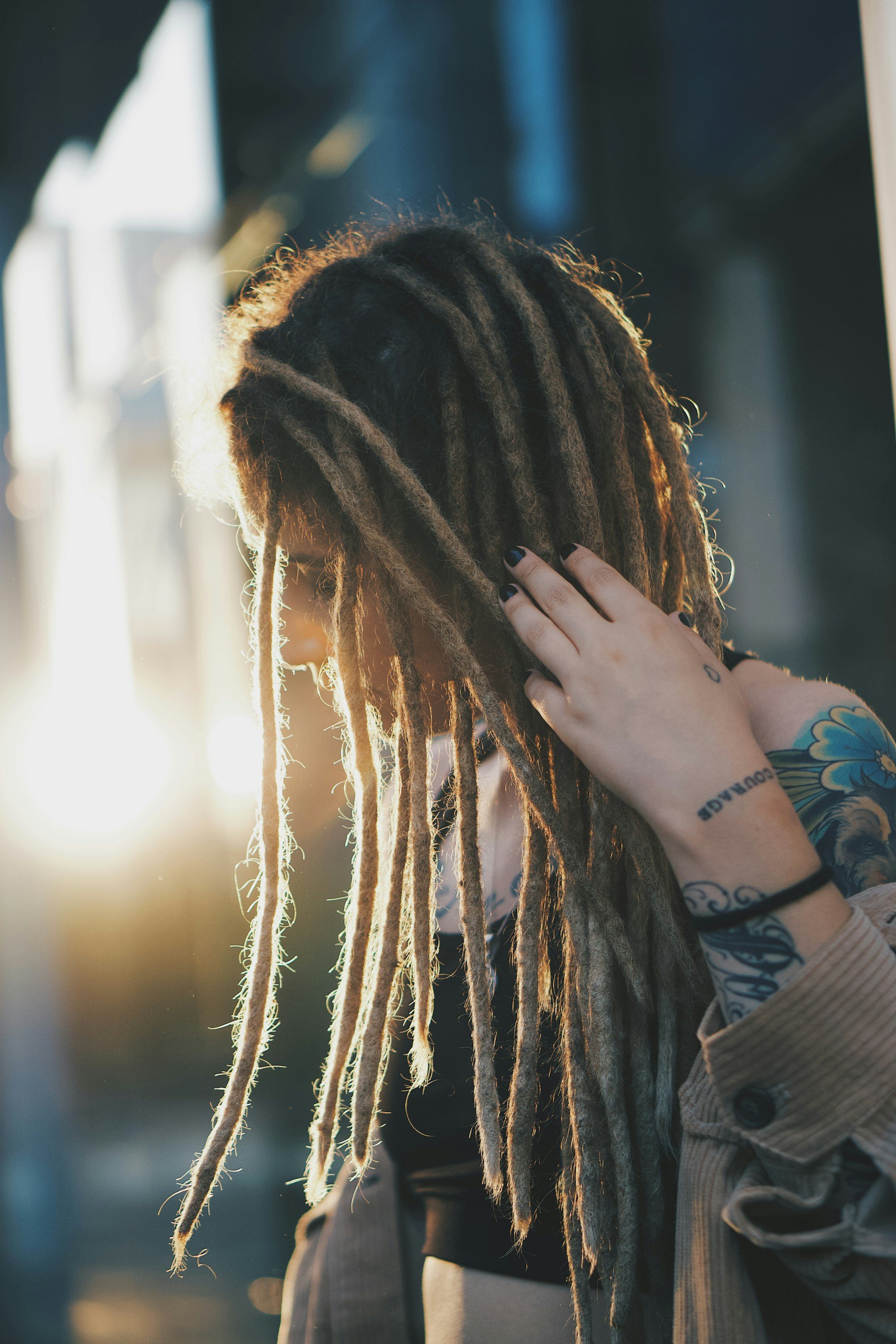
The best locs days are the ones where you did almost nothing.
The hair’s down or tossed into a loose knot, and the outfit looks just as easy.
That’s the whole idea of a nonchalant look, and loose styles pull less, so they’re easier on your scalp.
Locs is often considered the more culturally sensitive word for this hair, though some wearers still say dreads or dreadlocks.
Here are 5 easy ways to wear them, most with an outfit to match.
One thing first: locs worn too tight can cause traction alopecia, which is hair loss from constant pulling.
So every style below leans loose.
And honestly, a style that tugs at your hairline isn’t nonchalant anyway.
Not worth it.
Wear Them Down and Let Them Fall

The easiest style is no style.
Locs hanging loose around your face need a shake in the morning and nothing else.
2 or 3 gold cuffs or beads are plenty of extra.
Keep the outfit just as easy.
A cotton button-down worn untucked over a tank, or a printed shirt with a loose fit, lets the hair do the talking.
I love fabric with some drape, like linen or rayon, under heavy hair, because a stiff one fights it.
Cutoffs or wide-leg trousers finish it off (if the trousers are off the rack, a tailor can fix the inseam so they skim your shoes).
Our blue baggy jeans outfits have more relaxed combinations to borrow from.
Half-Up, Held Loosely

Half-up keeps the weight off your neck and the hair off your face.
Gather the top section at the crown with a scrunchie, a soft clip or a thin wrap of wire or cord, and leave the rest down.
It should feel secure, not like it’s pulling at your forehead or temples.
If it hurts, it’s too tight.
Loosen it until you can’t feel it at your hairline.
For the top, a black V-neck or scoop-neck in a fabric that drapes shows off your neckline, and with the hair up, 1 small pair of earrings is all you need.
I’m partial to the half-up, since it looks put together with the least effort.
Our thin locs hairstyles include more half-up ideas if you’d like a different version.
A Loose Topknot for Warm Days

A topknot is the quickest way to get locs off your shoulders.
Gather them at the crown, twist the bundle 1 or 2 times and hold it with a soft band.
Locs make a bun with a lot of volume, so a loose hold is enough.
That’s it.
A tightly pulled bun, ponytail or updo can cause traction alopecia, too.
It’s fine to pull your hair back tight every once in a while, but not often.
So rotate between the knot and a half-up.
I’d pick a knot you can shake out over one that needs pins.
A high bun balances a relaxed fit, like an oversized tee or a long cardigan with some drape.
A Scarf or Head Wrap Does the Dressing Up

Tie a square scarf at the side of your head, or knot a strip of fabric into the front section and let the locs hang.
It adds color for almost nothing, and a scarf from your closet works as well as a new one.
I’d go for a print, since it does more than a plain one.
Want to wear one lower down?
Our infinity scarf outfit ideas show how.
Tie it loosely, though.
Really.
A head scarf that rubs against your hair all the time can lead to traction alopecia, especially if you pull your hair back tightly before covering it.
Pull it back loosely under the scarf instead.
Silk or satin is gentler on hair than other materials.
Add a Hat With Room in the Band

A soft felt hat sits easily over locs and shades your face.
It looks best with layers in earth tones, like an olive field jacket, a patterned knit and dark pants, cut loose enough that you can move your arms.
Pick a hat with a little room in the band so it rests on your hair instead of squeezing it.
The same rubbing that scarves cause can come from a hat, so give your hair 2 or 3 days a week without one.
Keep Them Light and Dry, and Know the Warning Signs

Length can work against a nonchalant look.
Long locs look great swinging, but they can get heavy and pull on your scalp.
Keep them short, and go for thicker ones, to cut down on the pull.
Longer doesn’t always mean healthier.
Locs are usually worn for several years, so the strain from the extra weight adds up.
2 habits help.
Don’t twist locs too tightly at the root, and dry them thoroughly after you wash, because mould and mildew can build up in damp locs.
For natural, unrelaxed Afro-textured hair, a basic routine includes washing every 1 to 3 weeks, though how often depends on your hair type and products.
With locs, it’s worth working out a cleansing routine for your scalp and your locs that suits you.
If you wear styles that pull tightly, look at your hairline and scalp once a month.
Broken hairs around your forehead, a receding hairline and patches of hair loss where the hair is pulled tightly are the early signs.
And change the style right away if you notice any of these 4 things: pain, stinging, crusts on your scalp, or sections of scalp pulled up like a tent.
Traction alopecia can become permanent the longer it goes untreated.
If you notice symptoms, see a board-certified dermatologist.
Sources